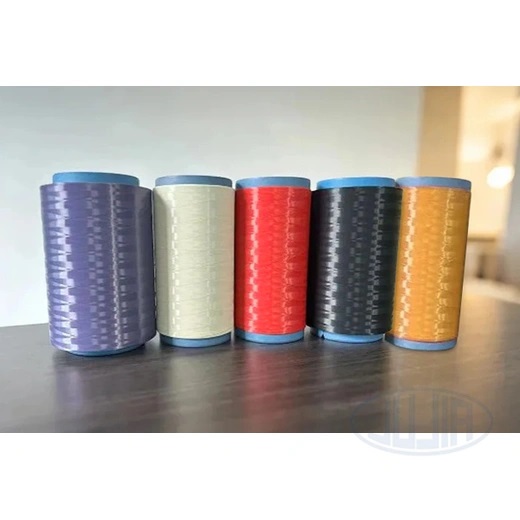
Liquid Crystal Polymer fiber/LCP fiber

Description
LCP, or polyarylate, fibers and para-aramid fibers both belong to liquid crystal polymer fibers. Their monomers both have a para-structure, and the molecular chains have similar arrangement characteristics. Therefore, they possess similar mechanical properties, such as high tensile strength, high modulus, low creep and other characteristics.
Features of LCP Fiber
1. High strength and modulus
2. Low Dk, Df
3. Outstanding cut resistance
4. Excellent creep resistance
5.Vibration damping property
6.Excellent flex/fold characteristics
7.Low coefficient of thermal
8. Heat resistance
9. Abrasion resistance
10. Chemical resistance
11. High impact strength
12. Low water absorption
13. Low volume expansion
14. High dielectric strength. expansion
The mechanical properties of LCP Fiber :
LCP fiber possess excellent mechanical properties:
1.The tensile properties of LCP fibers are similar to those of para-aramid fibers.
The tensile strength is higher than that of conventional para-aramid fibers and is similar to that of heterocyclic aramid fibers (such as Technora);
The elongation at break is similar to that of conventional para-aramid fibers and is slightly lower than that of heterocyclic aramid fibers (such as Technora).
2.Abrasion resistance performance: The yarn to yarn abraision resistance is significantly better than that of ordinary para-aramid fibers.
3.Other mechanical properties are also superior to those of conventional para-aramid fibers, including:
Creep
Bending resistance
Impact resistance
Cutting resistance
2,The abrasion resistance performance of LCP fiber:
Seen from the following table, in the case of yarn-to-yarn friction of LCP fiber, under dry rubbing conditions, the abrasion resistance is 15 times that of aramid fibers; under wet conditions, the friction performance of LCP fiber is 30 times that of aramid fibers. Therefore, the service life of LCP fiber could be much longer than that of aramid fibers.
The LD of filament of LCP fiber is between 3-5 denier (D), while that of aramid fibers is only 1.5 denier (D), so it is more prone to wear. Moreover, the energy required for the fibrillation of LCP fiber is more than that of aramid fibers, and the fiber structure is less likely to be damaged.
3,Creep performance of LCP fiber:
Under the condition of bearing 30% of the material's breaking strength, after different periods of time, the elongation of the material is as follows:
After 1000 hours, the aramid fiber will elongate by 0.5%, while the polyaryl ester fiber will only elongate by 0.15%
Anti-bending performance of LCP fiber
For both being 1500D filament materials, the bending resistance performance of LCP fiber is 20 times that of aramid fibers.
In the results of the folding test of cords with a diameter of 2mm, the number of times that the LCP cord can withstand bending is approximately 4 to 5 times that of the aramid cord.
Impact resistance of LCP fabrics
Compare the same para-aramid fabric and LCP fabric, and conduct the drop-weight impact test shown in the figure:
LCP fabric remains intact under an impact force of 11.3N.m (100 inch lbs);
The para-aramid fabric is already penetrated under an impact force of 57N.m (50 inch lbs);
Therefore, LCP have better safety performance under drop-weight impact.
Thecutting resistance performance of LCP fiber is about 3 times of p-aramid
Base on glove cutting resistance test mothed
The test result are showed as below:
Mterlal Denler D Relative Load
LCP Fiber,High Strengh 1500 304
LCP Fiber,Normal Strength 1500 2.2
P-Aramid 1500 1.1
UHMWPE 1500 1.0
Cold resistance:
At -60°C, the strength of LCP fiber increases by 18%, while that of p-aramid fibers decreases by 12%. The strength of LCP fiber is 30% higher than that of p-aramid fibers.
At -40°C, the strength of LCP fiber is 15% higher than that of p-aramid fibers.
Moisture Absorption of LCP Fiber
At 20℃, under the conditions of relative humidity in the air being 65%, 80% and 90% respectively:
The water absorption rate of LCP fibers is less than 0.1%, while p-aramid fibers are easy to absorb water, reaching 4.2%, 4.8% and 5.4% respectively.
Water absorption could seriously affect the processing performance of fibers and also affect their application in wet working conditions.
Heat Resistance Property
LCP is a thermoplastic material. As the temperature rises, its strength gradually decreases and it completely loses its strength before 350℃.
While, p-aramid is a thermosetting material that does not melt. Therefore, the increase in temperature has less impact on p-aramid.
However, aramid is prone to thermal oxidation at high temperatures. Therefore, after being thermally aged and tested at normal temperature, the strength of p-aramid will suffer a larger loss.
At a temperature of 250℃, the strength of p-aramid and LCP fibers measured at room temperature after different exposure times are as follows.
This value characterizes the thermal oxidation resistance of the material: P-aramid is prone to oxidation when exposed to hot air at high temperatures.
The applications of LCP Fiber
LCP Fiber: Enabling High-End Applications with Exceptional Performance
Polyarylate fiber (LCP fiber) is a high-performance material known for its ultra-high strength and high modulus. It exhibits extremely low creep and superior dimensional stability, maintaining its shape and performance even under prolonged loading.
Particularly notable is the outstanding performance of LCP fiber in low-temperature environments. For example, in cold settings such as the stratosphere, where most materials deteriorate, the breaking strength and tensile modulus of polyarylate fiber actually increase significantly. This unique characteristic ensures reliable structural integrity and functionality even under extreme temperature conditions.
Thanks to these exceptional properties, LCP fiber is widely used in demanding fields such as:
- Aerospace: Ideal for stratospheric aircraft, satellite components, and space tethers, where adaptability to low temperatures and high vacuum is critical.
- Precision Instruments & Optical Equipment: Suitable for high-precision sensors, measuring devices, and optical mounts due to its high dimensional stability and low creep.
- High-End Sports & Outdoor Gear: Used in ultra-lightweight, high-strength climbing ropes, high-performance sailing lines, and premium bicycle components.
- Industrial & Protective Applications: Employed in industrial cables, protective armor, and specialty composite reinforcements that require long-term tension resistance and stability under high or low temperatures.
The applications of LCP Fiber / Coated fabrics for high - altitude balloons and high - altitude airships:
Characteristics of LCP Fiber:
High strength and high modulus.
Extremely low creep and better dimensional stability.
The ambient temperature in the stratosphere is low. At low temperatures, the breaking strength and tensile modulus of polyaryl ester fiber materials are increased instead.
Main types:HTH400D,HTH750D,HTH1000D
The applications of LCP Fiber / Flexible oil and liquid storage bags:
Characteristics of LCP Fiber:
High strength and high modulus
Low water absorption
Low creep
Main Types:HTS1000D,HTS1500D
The applications of LCP Fiber / LCP fiber reinforced TPU high-pressure hoses have been widely used in the exploitation of shale oil, coal mining, etc.
Characteristics of LCP Fiber:
Extremely low water absorption performance
High modulus and high strength
Ultra-high bending resistance performance
Good oil resistance and chemical resistance
Main types:HTH1500D,HTS1500D,HTS3000D
The applications of LCP Fiber / LCP fibers are used in the optical cable industry, including:
FTTH Cable
ADSS Cable
Mobile optical cables
Tethered optoelectronic composite cables
Guided - missile optical cables
Rip cord
other optical cables for special requirements, such as those for special working places like the seabed and plateau areas.
Main types:HTH50D,HTH100D,HMSS1000D,1500D,3000D
LCP fibers can be used not only directly as the reinforcement of optical cables but also processed into FRP for the enhancement of optical cables.
FRP made of LCP fibers has the following advantages:
The processing cost of FRP is lower than that of aramid;
The tensile modulus is higher than that of aramid.
In addition, LCP fibers can also be used to process water - blocking yarns.
Main types:HMSS1000D,HMSS1500D
LCP fiber has the following advantages when used in heavy-duty conveyor belts:
High strength and high modulus >>It enables long-distance operation, high load-bearing capacity, light self-weight, and low energy consumption.
Good abrasion resistance>> It can effectively reduce the friction between yarns.
Low water absorption and no corrosion>> It is more suitable for long-term use in humid environments.
Higher strength and modulus in low-temperature environments>> It is beneficial for the operation of conveyor belts in extremely cold regions.
Higher cut resistance and impact resistance>>It makes the operation of the conveyor belt safer and the maintenance easier.
Less carbon dioxide emissions during the production process, making it more environmentally friendly.
Main types:HTC1500D,HTC3000D
The applications of LCP Fiber / Ropes and Cables:
High strength and high modulus;
Better wear resistance;
Extremely low creep;
No water absorption
Main types:HTH1500D,HTS1500D
Summarize
LCP fibers have similar mechanical properties to para-aramid fibers, both featuring high tensile strength, high tensile modulus, and low creep.
Compared with para-aramid fibers, LCP fibers have better abrasion resistance, bend resistance, and cutting/impact resistance. Their water absorption rate is lower.
The heat resistance and chemical resistance of liquid crystal polyaryl ester fibers are different from those of para-aramid fibers.
There is less carbon dioxide emissions during the production process, which is more in line with the requirements of developing a dual-carbon economy.
Ningbo Jujia has fully achieved the independence of the entire industrial chain of LCP fibers, significantly reducing costs and eliminated the dependence on Western products and technologies.
- Brand
- copolymen
- Model
- 300D 500D 1500D 1600D
- Country of origin
- china