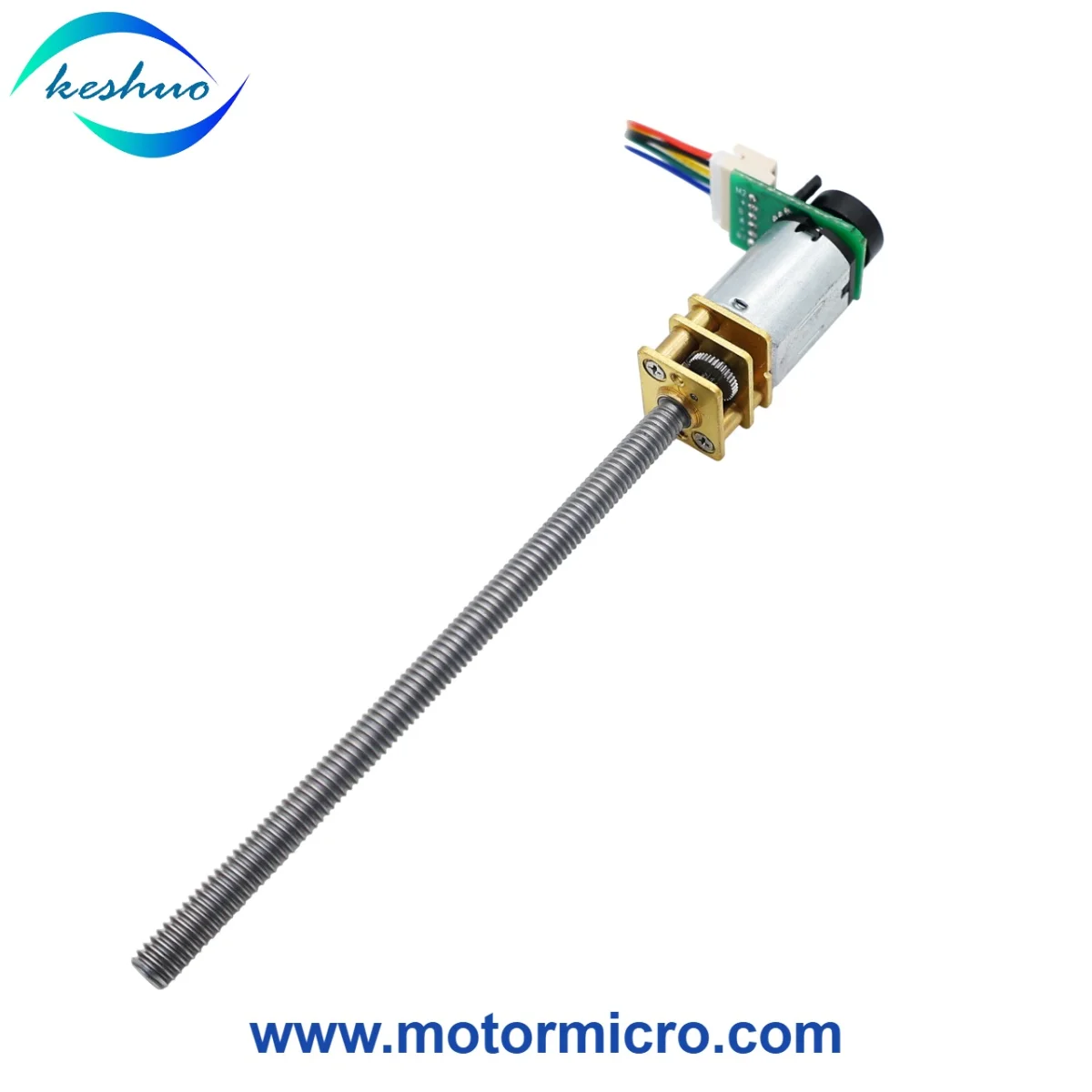
KS-GM12-N20-00751 6V DC Gear Motor, 70mm Lead Screw, Magnetic Encoder

Description
KS-GM12-N20-00751 DC Gear Motor with Lead Screw and Magnetic Encoder
The KS-GM12-N20-00751 is a miniature brushed DC gear motor manufactured by Keshuo Motor. It combines a 6 V N20 motor, a metal reduction gearbox, a 70 mm lead screw and a six-wire magnetic encoder for compact motorized mechanisms requiring linear movement and rotational feedback.
The motor body measures Ø12.0 × 15.2 mm, excluding the gearbox, lead screw and encoder assembly. The reference configuration has a listed no-load speed of 99.4 rpm and a magnetic encoder with a nominal 7 PPR specification.
When paired with a compatible lead screw nut and guide mechanism, the rotating screw can produce linear displacement. Encoder signals can be used by an external controller to monitor motor rotation.
Main Technical Specifications
Model: KS-GM12-N20-00751
Manufacturer: Keshuo Motor
Motor Type: Brushed DC Gear Motor
Motor Series: N20
Rated Motor Voltage: 6.0 V DC
Motor Body Diameter: 12.0 mm
Motor Body Length: 15.2 mm
Gearbox: Metal Reduction Gearbox
Lead Screw Length: 70.0 mm
Feedback Device: Magnetic Encoder
Encoder Connection: Six-wire Assembly
Encoder Resolution: Listed as 7 PPR
Encoder Supply Voltage: 3.0 V DC
The motor body dimensions do not represent the overall length of the complete assembly. Gearbox dimensions, lead screw thread specifications and encoder housing dimensions should be checked against the mechanical drawing.
Motor Performance
KS-GM12-N20-00751 – 6 V Configuration
Rated Voltage: 6.0 V DC
No-load Current: 16.0 mA
No-load Speed: 99.4 rpm
Listed Starting Torque: 408 g·cm
Starting Voltage: 1.15 V DC
Stall Current: 0.133 A
These values are based on the supplied reference datasheet.
The 99.4 rpm figure is listed as the no-load speed of the geared motor configuration. Actual operating speed and current will change with the applied mechanical load.
The starting torque value should not be treated as continuous working torque. The available axial force at the lead screw nut also depends on screw lead, mechanical efficiency and load conditions.
Magnetic Encoder Configuration
The motor assembly includes a six-wire connection consisting of two motor power wires and four encoder wires.
The reference encoder is specified as 7 PPR and provides two signal channels, A and B, for monitoring motor rotation.
Reference Wiring Information
Red: Motor Negative (-)
White: Motor Positive (+)
Black: Encoder Positive Supply, 3.0 V DC
Blue: Encoder Ground
Green: Encoder Signal A
Yellow: Encoder Signal B
The motor and encoder have separate supply voltage requirements.
The 6 V motor supply must not be applied directly to the encoder's 3 V supply input.
The wiring color assignments should be confirmed against the supplied connection diagram before electrical integration.
Encoder pulse resolution and the relationship between motor shaft rotation and gearbox output rotation should also be verified before calculating positioning accuracy or displacement.
Lead Screw and Linear Motion
The reference model uses a 70 mm lead screw connected to the gearbox output.
Lead screw rotation can be converted into linear movement through a matching threaded nut. The nut requires a suitable mechanical guide or anti-rotation arrangement to produce controlled travel.
Important mechanical parameters include:
Lead Screw Length: 70 mm
Thread Diameter and Pitch: To be confirmed
Compatible Nut: According to the selected thread
Effective Linear Stroke: Depends on the assembly
Linear Travel per Revolution: Determined by screw lead
Available Axial Force: Depends on gearbox output torque and transmission efficiency
The 70 mm lead screw length should not be interpreted as 70 mm of effective linear travel.
A complete positioning mechanism also requires suitable mounting, guidance and travel limits.
Applications
The KS-GM12-N20-00751 can be evaluated for compact motorized equipment requiring lead screw movement and rotational feedback.
Miniature Linear Positioning
Small positioning mechanisms using a threaded nut and guide rail to control linear movement.
Laboratory Instruments
Compact sample adjustment mechanisms and low-load positioning assemblies in laboratory equipment.
Robotics and Automation
Small mechanical linkages and linear adjustment mechanisms requiring motor rotation feedback.
Optical and Measurement Equipment
Short-distance adjustment mechanisms where installation space is limited and movement needs to be monitored.
Prototype Motion Systems
Educational and experimental motion assemblies using a DC motor, lead screw and encoder-based control.
The final application should be evaluated according to the required axial load, operating speed, travel range, positioning requirements and mechanical design.
OEM Customization
Keshuo Motor supports custom configurations of miniature DC gear motors and lead screw assemblies.
Depending on the motor structure and project requirements, customization options may include:
Motor Voltage and Winding Specifications
Gearbox Reduction Ratio
Lead Screw Length
Thread Diameter and Pitch
Compatible Lead Screw Nut
Encoder Configuration
Lead Wire Length and Connectors
Mechanical Installation Requirements
For encoder-based motion control, the selected gearbox ratio, encoder signal resolution and mechanical transmission should be reviewed together.
Sample Development and Ordering
Model: KS-GM12-N20-00751
Availability: Pre-order only. Currently unavailable for immediate shipment.
Estimated Production Lead Time: 10–15 business days after order confirmation, subject to configuration and production scheduling.
For custom samples or volume production inquiries, please provide:
Required Motor Voltage
Gearbox Output Speed
Working Torque or Axial Load
Lead Screw Length and Pitch
Required Linear Travel
Encoder and Controller Requirements
Available Installation Dimensions
Operating Duty Cycle
Estimated Order Quantity
All technical specifications are preliminary and should be confirmed through dimensional drawings, electrical testing and sample evaluation before production approval.